

Table of Contents
- Why Plantar Fasciitis Lingers Without the Right Approach
- Understanding Root Causes Beyond the Surface
- How Acupuncture Addresses Plantar Fasciitis at Its Source
- The Power of Manual Therapies in Your Recovery
- Why We Combine Both Modalities for Optimal Results
- Personalized Diagnostics to Guide Your Treatment Plan
- What to Expect During Your Recovery Journey
- Supporting Healing With Functional Nutrition and Lifestyle
- Our Integrated Approach to Lasting Pain Relief
- Frequently Asked Questions (FAQ)
Why Plantar Fasciitis Lingers Without the Right Approach
Plantar fasciitis doesn’t resolve quickly because standard approaches address only the symptom, not the mechanism driving it. Most patients receive a cortisone injection, a night splint, and a recommendation to rest, stretch, and ice. Within weeks, the pain returns because the underlying dysfunction persists. At WellFit Studio, we’ve built our plantar fasciitis recovery protocol around a different premise: when you address root causes with precision, healing accelerates.
The combination of acupuncture and manual therapy creates what we call a “cascade protocol.” These modalities work synergistically to reduce inflammation, restore tissue mobility, correct biomechanical patterns, and rebalance the nervous system. The result is measurable improvement within 4-8 weeks for most patients, along with confidence that pain won’t simply cycle back.
Plantar fasciitis becomes chronic when the fascia itself remains tight, the calf and foot muscles stay locked in compensation patterns, and the nervous system keeps signaling threat. A standard stretch routine addresses none of these.
Most treatment plans focus on the heel because that’s where patients feel the sharpest pain. But pain location isn’t the same as pain source. The plantar fascia is a band of connective tissue running along the bottom of your foot that provides arch support during movement. When it becomes inflamed, micro-tears develop. The inflammation itself is protective, but when inflammation becomes chronic and the tissue doesn’t gain full mobility, you’re stuck in a cycle where each step retraumatizes the same area.
Conventional approaches miss critical factors:
- Calf tightness that forces your foot to compensate with excessive arch tension
- Foot and ankle immobility that prevents normal shock absorption during walking or running
- Hip and lower back dysfunction that changes how load distributes through your feet
- Nervous system sensitivity that amplifies pain signals even after tissue healing begins
- Lifestyle and movement patterns that created the condition initially
Without addressing these, rest alone won’t resolve the problem. The fascia needs active engagement, not just rest.
Understanding Root Causes Beyond the Surface
Plantar fasciitis rarely appears in isolation. It’s an outcome of systemic dysfunction, and identifying that dysfunction is where recovery truly begins.
The most common pattern we observe involves kinetic chain breakdown. Your body is an integrated system: if your hip stabilizers are weak, your glutes under-activate, and compensation ripples downward. Your foot has to work harder. Your calf becomes overactive. Your plantar fascia bears load it wasn’t designed to carry alone. Within weeks or months, inflammation develops.
Other root causes include:
- Restricted ankle mobility from old sprains, tight calves, or years of wearing restrictive footwear
- Postural imbalance that increases stress on the arch during standing and walking
- Inflammatory load from gut dysfunction, food sensitivities, or chronic stress that slows tissue repair
- Nervous system hypersensitivity from ongoing pain signals that keep muscles guarded even after structural damage heals
- Repetitive strain patterns specific to your work, exercise routine, or daily habits
This is why generic treatment protocols fail. A desk-bound executive with tight calves and hip weakness needs a different plan than an athlete with ankle mobility loss and compensation from training volume.
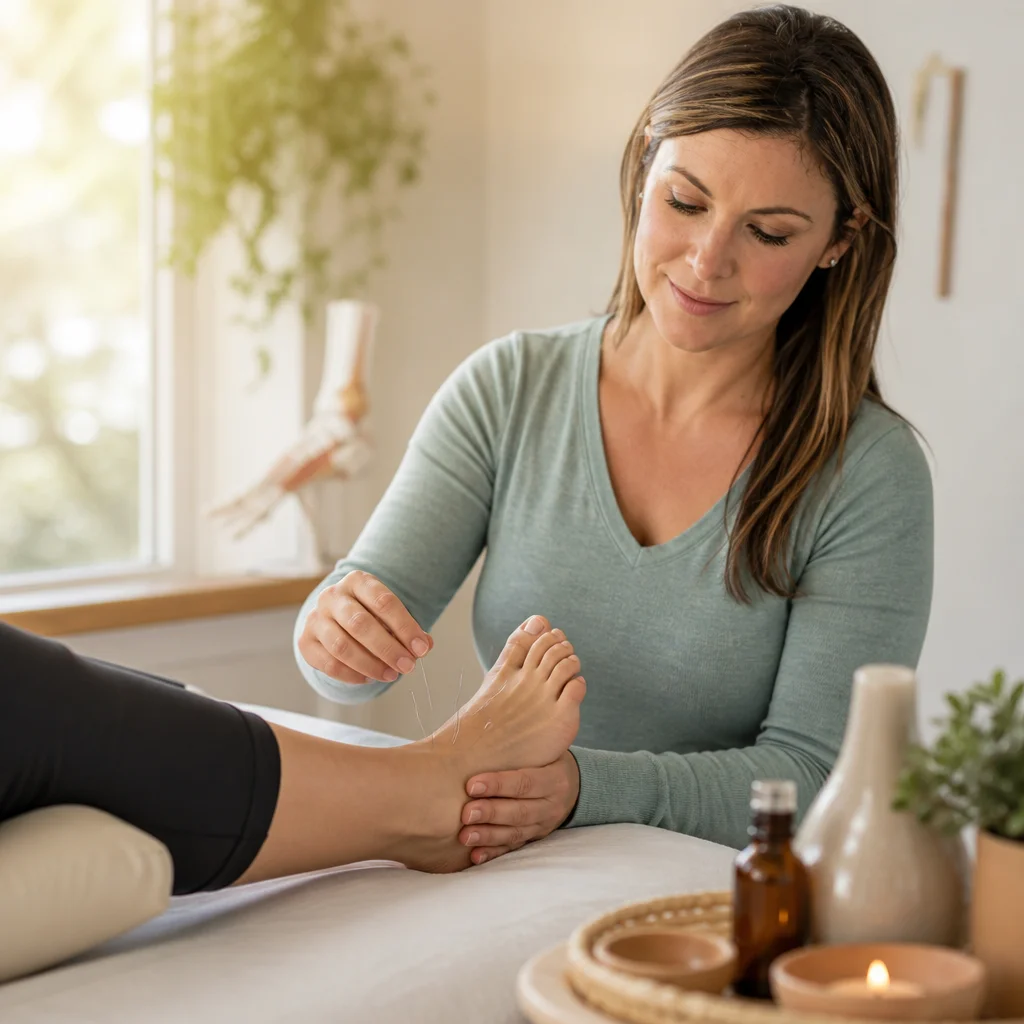
We start every plantar fasciitis case with a functional assessment that examines your ankle mobility, calf flexibility, hip strength, gait mechanics, and postural alignment. We also order functional lab testing when appropriate to evaluate systemic inflammation markers. This diagnostic clarity guides everything that follows.
How Acupuncture Addresses Plantar Fasciitis at Its Source
Acupuncture reduces pain and restores function through multiple mechanisms that conventional care overlooks. It’s not mystical; it’s measurable physiology.
When we place needles in specific locations around your foot and lower leg, we activate a cascade of local and systemic responses. Locally, acupuncture triggers the release of endogenous opioids and increases blood flow to areas with restricted circulation. For plantar fasciitis, improved blood flow directly accelerates tissue healing by delivering oxygen and removing inflammatory byproducts that prolong pain signaling.
Beyond local effects, acupuncture down-regulates nervous system sensitivity. Chronic pain creates a self-reinforcing loop: pain causes muscle guarding, guarding restricts movement, restriction perpetuates pain. This loop lives in your nervous system, not just in your tissue. Acupuncture interrupts this pattern by activating your parasympathetic nervous system (your rest-and-repair mode), allowing muscles to relax and pain signals to decrease even before tissue changes fully occur.
We also use acupuncture to address the kinetic chain dysfunction we identified during your assessment. Points along your calf, hip, and lower back can normalize muscle activation patterns that have been compensating for foot dysfunction. This is precision acupuncture, not generic point selection.
Treatment frequency matters. For acute plantar fasciitis, we typically recommend twice-weekly sessions for 3-4 weeks, then transition to weekly maintenance as improvement accelerates. The consistency allows the nervous system to establish new, calmer baselines and supports tissue remodeling over time.
The Power of Manual Therapies in Your Recovery
Manual therapy restores tissue mobility and biomechanical function in ways that needles alone cannot. We employ targeted soft tissue work and structural techniques designed specifically for plantar fasciitis patterns.
Myofascial release of your calf, intrinsic foot muscles, and plantar fascia itself reduces the chronic tension that perpetuates inflammation. Unlike a deep tissue massage, which offers temporary relief, our approach targets the specific restrictions limiting movement. We work on the tissue itself, on the fascia surrounding the muscles, and on the trigger points creating referred pain patterns.
Joint mobilization of your ankle and foot restores normal arthrokinematics. Your ankle has natural glide and rotation patterns that allow shock absorption and load distribution. When these patterns are lost due to old injuries or chronic immobility, your foot has to compensate. Mobilization restores this natural movement, immediately reducing demand on your plantar fascia.
Gait training completes the picture. Once we’ve restored tissue mobility and normalized muscle activation, we teach you how to move differently. Most people with plantar fasciitis have developed gait patterns that perpetuate the condition. You might be gripping your toes, over-pronating, or avoiding push-off from your calf. We identify these patterns and reprogram them.
Manual therapy sessions typically last 45-60 minutes and address multiple regions simultaneously. You won’t receive 30 minutes of foot work and call it a day; we work holistically, addressing your calf, hip, and lower back alongside foot-specific techniques.
Why We Combine Both Modalities for Optimal Results
Acupuncture and manual therapy complement each other in ways that neither alone can replicate. We call this integrated treatment because it’s truly integrated, not sequential.
Acupuncture prepares tissue for manual work. By relaxing your nervous system and improving local blood flow, acupuncture makes manual therapy more effective and more comfortable. Tissue that’s less guarded and better perfused responds faster to mobilization and myofascial release.
Manual therapy creates mechanical change that acupuncture then helps your body consolidate. When we restore your ankle mobility or release fascia tension, acupuncture helps your nervous system “learn” these new positions and patterns, preventing rebound tension.

This combination accelerates recovery by addressing multiple dimensions simultaneously: nervous system sensitivity, tissue quality, mobility, strength, and movement patterns. We see measurable pain reduction faster than either modality alone produces, and the improvement sustains because we’ve addressed root mechanisms, not just symptoms.
Your treatment schedule might look like this: acupuncture twice weekly and manual therapy once weekly for the first 4-6 weeks, with adjustments based on your progress. As pain diminishes and function improves, we scale back frequency while maintaining consistency.
Personalized Diagnostics to Guide Your Treatment Plan
We don’t begin treatment with assumptions. Every patient receives a tailored assessment that informs their specific protocol.
Our diagnostic approach combines clinical examination with advanced testing. We assess your ankle dorsiflexion and plantarflexion range, calf flexibility using the Silfverskiöld test, hip strength and stability, and gait mechanics. We palpate your plantar fascia, identify trigger points, and note pain patterns.
When appropriate, we recommend functional lab testing to evaluate systemic inflammation, gut health markers, or micronutrient status. Chronic plantar fasciitis sometimes reflects underlying inflammatory load from food sensitivities, dysbiosis, or nutritional deficiency. Addressing these accelerates healing at every level.
We also consider your functional goals. An executive walking 4 miles daily needs different treatment emphasis than a runner training for distance. A patient with an old ankle sprain requires different mobility work than one with postural imbalance from desk work.
This diagnostic precision is what distinguishes root-cause recovery from generic treatment protocols. You’re not following a template; you’re receiving a plan designed for your specific presentation and goals.
What to Expect During Your Recovery Journey
Plantar fasciitis recovery follows a predictable arc when the right protocol is in place. Understanding what to expect builds confidence and keeps you engaged.
Weeks 1-2: Pain typically decreases 20-30% as nervous system sensitivity down-regulates and inflammation begins to resolve. You’ll notice the first step out of bed hurts less, and nighttime pain diminishes. Swelling may reduce visibly.
Weeks 3-4: Mobility improves noticeably. Your ankle moves easier, your calf feels less perpetually tight, and your gait becomes more natural. Pain with walking continues to decrease. This is when most patients regain confidence in their feet.
Weeks 5-8: You return to normal activities without modification. Walking, stairs, and light exercise no longer trigger pain or increased inflammation. Occasional minor discomfort may appear after high-demand activities, but it resolves quickly rather than lingering for days.
Beyond week 8: Maintenance becomes about prevention. You continue acupuncture monthly or as-needed, you’ve integrated the movement and lifestyle practices we taught you, and you understand the patterns that created the original condition so you can recognize early warning signs.
Recovery isn’t linear. Some weeks you’ll notice bigger improvements than others. This is normal and reflects the body’s natural healing rhythms.
Supporting Healing With Functional Nutrition and Lifestyle
Tissue repair requires specific nutritional support. We integrate personalized nutrition guidance into every patient’s protocol because treating plantar fasciitis while ignoring nutritional status is treating half the problem.

Key nutritional considerations include:
- Protein intake adequate for tissue remodeling (approximately 1 gram per pound of target body weight)
- Collagen and gelatin to support connective tissue repair, especially in the fascia
- Omega-3 fatty acids to modulate inflammation and support tissue quality
- Micronutrients including vitamin C, zinc, and magnesium that are essential for collagen synthesis and tissue healing
- Hydration to maintain tissue elasticity and allow for optimal fascial mobility
Beyond nutrition, lifestyle modifications accelerate healing. We guide you on foot care practices, appropriate footwear selection, home mobility exercises, and activity modification during recovery. You’ll learn which stretches and strengthening movements support your healing versus those that aggravate your condition.
We also address chronic stress management because nervous system dysregulation perpetuates inflammation and pain sensitivity. For many high-performing professionals, stress reduction is the most overlooked component of physical recovery.
Our Integrated Approach to Lasting Pain Relief
Plantar fasciitis recovery isn’t complex, but it requires precision and integration. At WellFit Studio, we’ve designed our protocol specifically for driven, accomplished professionals who refuse to settle for temporary fixes or conveyor-belt treatment.
Your recovery begins with a thorough assessment that identifies the mechanisms driving your pain. From that foundation, we design an integrated treatment plan combining acupuncture’s nervous system and tissue benefits with manual therapy’s mechanical restoration. We support your healing with personalized nutrition guidance and lifestyle practices. Throughout your journey, we track measurable progress and adjust your plan based on real results.
The outcome is faster recovery, lasting pain relief, and the confidence that you’ve addressed root causes rather than masked symptoms. Your feet won’t just feel better; they’ll function better because the underlying dysfunction has been resolved.
If plantar fasciitis has sidelined you or limited your activities, your next step is a consultation where we’ll assess your specific situation and outline a personalized recovery pathway. We invite accomplished professionals in the Boston area to experience the precision, care, and results that set integrated root-cause medicine apart.
For further reading: Root cause acupuncture care.
Frequently Asked Questions (FAQ)
How quickly can I expect to feel relief from plantar fasciitis with your combined acupuncture and manual therapy approach?
Most of our patients begin noticing meaningful improvements within 4-6 weeks of consistent treatment, though this varies based on how long you’ve been experiencing pain and your individual healing response. We’ve found that combining acupuncture with manual therapy accelerates recovery because we’re addressing both the inflammatory response and the underlying biomechanical restrictions simultaneously. Your personalized treatment plan will give us a clearer timeline once we’ve completed our functional diagnostics and assessed your specific condition.
Why do you recommend combining acupuncture with manual therapy instead of just one treatment?
We’ve observed that plantar fasciitis rarely responds optimally to a single modality because the issue involves multiple layers: inflammation, fascial restriction, muscular tension, and often imbalances in how your body distributes weight and movement. Acupuncture reduces pain signaling and inflammation while improving blood flow to the affected tissue, while manual therapy directly releases the fascial restrictions and corrects movement patterns that perpetuate the problem. Together, these approaches work synergistically to resolve the root causes rather than just masking symptoms temporarily.
What role does nutrition and lifestyle play in your plantar fasciitis recovery plan?
We integrate functional nutrition guidance and lifestyle adjustments into every patient’s care because heel pain often reflects deeper systemic issues like chronic inflammation, nutritional deficiencies, or movement patterns that need correction. Our health coaches work with you to identify foods and habits that either support or sabotage your healing, ensuring your body has the resources it needs to repair damaged tissue. This holistic perspective is what distinguishes our approach and helps us achieve lasting results rather than recurring problems.


