

Table of Contents
- The Mobility Crisis: Why Osteoarthritis Steals More Than Just Movement
- Understanding Osteoarthritis at the Root: Where Conventional Care Falls Short
- How Acupuncture Addresses the Mechanisms Behind Joint Dysfunction
- The Science-Based Timeline: Setting Realistic Expectations for Your Results
- Functional Medicine Integration: Treating Osteoarthritis Beyond the Joint
- Personalized Diagnostics: Uncovering What Your Lab Tests Miss
- Movement Restoration Through Our Multi-Modality Approach
- Real Outcomes: What Improved Mobility Actually Looks Like for Our Clients
- Why Your Lifestyle Matters: Nutrition and Coaching for Lasting Progress
- Getting Started at WellFit Studio: Your Personalized Mobility Assessment
- Frequently Asked Questions (FAQ)
The Mobility Crisis: Why Osteoarthritis Steals More Than Just Movement
Osteoarthritis doesn’t announce itself with fanfare. It arrives quietly—a stiff morning, a hesitation climbing stairs, a knee that protests after sitting too long. For driven professionals, this slow erosion of mobility feels like a betrayal of a body that’s always kept pace with ambition. You’re not looking for sympathy; you’re looking for a solution that actually works.
At WellFit Studio, we’ve spent years helping Boston’s most accomplished residents restore the movement and vitality they thought they’d lost. Acupuncture, paired with functional medicine diagnostics and personalized support, can meaningfully improve your mobility—but only if you understand what’s actually happening in your joints and what realistic progress looks like.
Osteoarthritis is progressive cartilage degradation, but its impact extends far beyond the joint itself. When you lose smooth, pain-free movement, you lose independence. You stop hiking. You avoid certain chair positions. You plan your day around what your body can handle, rather than what you want to accomplish.
The cascade effects are profound. Limited mobility leads to muscle weakness around the affected joint, which accelerates further degeneration. Compensatory movement patterns create pain in adjacent areas—a bad knee changes how you walk, which stresses your hip and lower back. Sleep suffers when you can’t find a comfortable position. Mood and energy decline when you’re sedentary and in pain.
Most people discover their osteoarthritis through imaging or when pain becomes unavoidable. By that point, conventional approaches typically offer anti-inflammatories, corticosteroid injections, and eventually surgery. These tools have a place, but they don’t address the mechanisms driving the deterioration in the first place. That’s where our integrated approach makes the difference.
Understanding Osteoarthritis at the Root: Where Conventional Care Falls Short
Osteoarthritis presents as a structural problem—cartilage loss is visible on X-ray—but structure is a symptom, not the cause. Joint degeneration accelerates when the body lacks the nutritional and biochemical resources needed to maintain cartilage integrity, when inflammatory signaling is chronically elevated, and when movement patterns are inefficient or restricted.
Conventional medicine excels at managing symptoms once damage is visible. What it typically misses is why the damage occurred in the first place. Are you dealing with systemic inflammation from unidentified food sensitivities? Is your body struggling to produce adequate collagen because of nutritional gaps? Are your movement patterns creating uneven stress distribution across the joint? Is hormonal imbalance contributing to joint stiffness and cartilage breakdown?
These questions require investigation beyond standard X-rays and MRI scans. They require looking at your complete biochemistry, movement quality, lifestyle patterns, and the constitutional factors that acupuncture practitioners recognize as essential to understanding your condition. When we treat osteoarthritis, we’re not treating a radiographic finding; we’re treating you.
How Acupuncture Addresses the Mechanisms Behind Joint Dysfunction
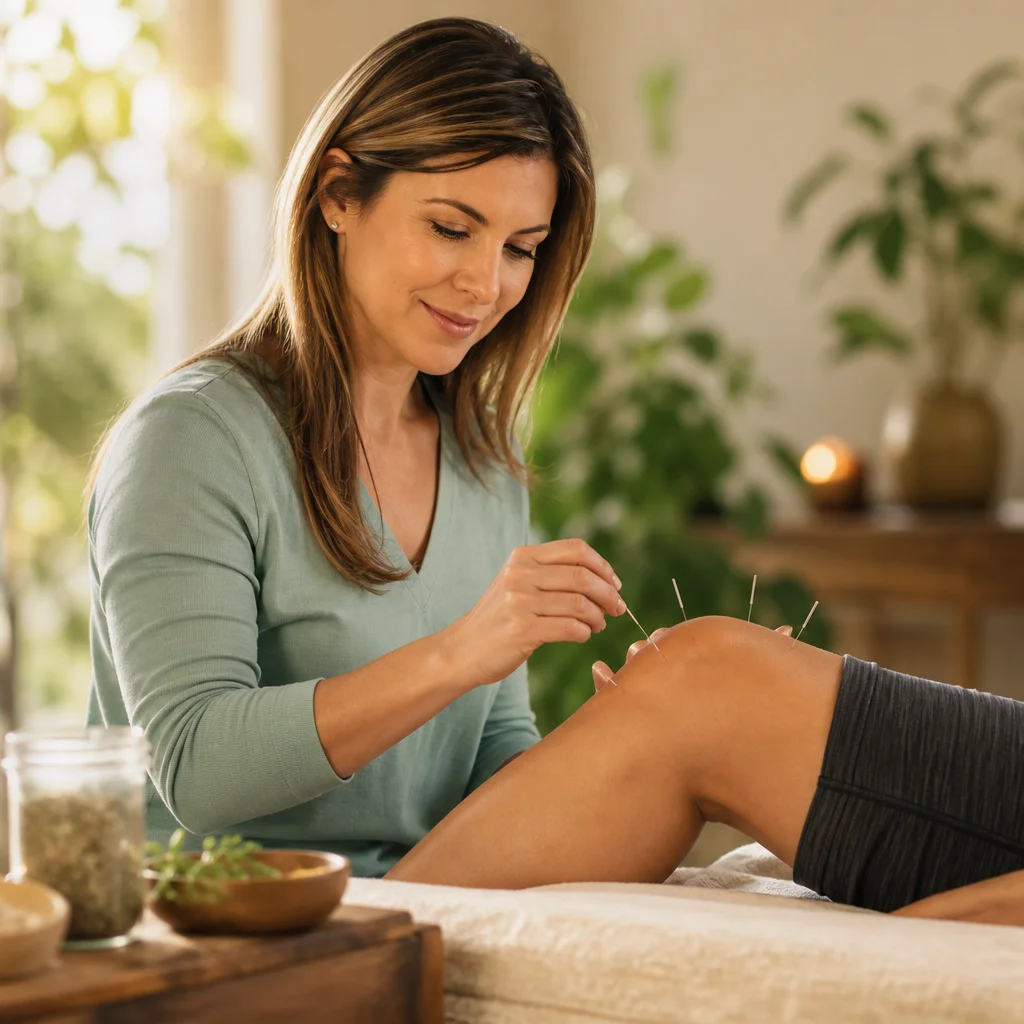
Acupuncture works through multiple overlapping mechanisms that directly support joint health and mobility. Needling specific acupuncture points stimulates local blood flow to affected joints, improving nutrient delivery and waste clearance. This isn’t metaphorical—studies consistently show acupuncture increases microcirculation in treated areas, which is exactly what chronically stiff, inflamed joints need.
Acupuncture also modulates the nervous system’s inflammatory response. Osteoarthritis pain often becomes disproportionate to the actual tissue damage present, because chronic pain rewires how your nervous system processes joint signals. Acupuncture interrupts this pain amplification pattern by activating parasympathetic tone and reducing inflammatory cytokine production.
Beyond pain relief, acupuncture stimulates mechanoreceptors in the joint space and surrounding tissues, enhancing proprioception and movement coordination. Many people with osteoarthritis develop guarded movement patterns because they’re unconsciously protecting the joint. Improved proprioceptive feedback allows you to move with more confidence and efficiency, which reduces compensatory stress on surrounding structures.

The timeframe matters here. Acupuncture is not a quick fix. Expect 4-8 weeks of consistent treatment before you notice substantial improvement in mobility. This isn’t a limitation; it’s a sign that genuine healing is underway, not just temporary symptom suppression.
The Science-Based Timeline: Setting Realistic Expectations for Your Results
We’re direct about what acupuncture can and cannot do, because realistic expectations are the foundation of committed treatment.
In the first 2-3 weeks, most people notice reduced pain severity and slightly improved sleep. Your nervous system begins downregulating its threat response to movement. This is meaningful but not transformative.
Weeks 4-8 are when mobility improvements become noticeable. Pain during specific activities—walking, climbing stairs, sitting for extended periods—decreases noticeably. You might discover you can do something you’d abandoned months ago. Range of motion often increases. This is the window where you’ll feel your investment is working.
By 8-12 weeks of consistent treatment, many clients report substantially restored mobility, improved strength in the affected joint, and a genuine sense of recovery. Some notice they’ve naturally become more active because movement no longer hurts.
This timeline assumes consistent treatment—typically 1-2 sessions weekly for the first 4-6 weeks, then spacing out as improvement stabilizes. It also assumes you’re making lifestyle changes alongside treatment. Acupuncture creates the conditions for healing; your daily choices determine whether that healing momentum continues.
Functional Medicine Integration: Treating Osteoarthritis Beyond the Joint
Our approach to your mobility isn’t confined to acupuncture needles. We integrate functional medicine diagnostics and personalized protocols because what happens in your bloodstream directly affects cartilage integrity and inflammatory status.
Nutritional deficiencies are common culprits in accelerated osteoarthritis. Insufficient vitamin D impairs cartilage maintenance and increases pain signaling. Low omega-3 levels fail to control inflammatory activity. Inadequate protein intake limits your body’s ability to rebuild cartilage and support muscle around the joint. These aren’t speculative—they’re measurable and addressable.
We also assess your gut health, because intestinal inflammation drives systemic inflammation that reaches every joint. Food sensitivities, dysbiosis, and intestinal permeability can perpetuate joint pain even when acupuncture is working beautifully. Healing the root requires addressing this.
Hormonal balance matters too. Estrogen supports collagen production and joint stability; when hormones decline, joints often become more symptomatic. Thyroid dysfunction slows tissue repair. These factors are testable and correctable through our functional medicine protocols.
Our functional medicine approach to osteoarthritis is bespoke. We order advanced lab testing specific to your presentation, then use those results to design a precise treatment plan—not a generic protocol.
Personalized Diagnostics: Uncovering What Your Lab Tests Miss
Standard osteoarthritis workup typically includes imaging and a physical exam. Functional medicine requires deeper investigation. We use advanced nutritional analysis, inflammatory marker testing, and micronutrient panels that conventional rheumatology often skips.
Here’s what makes the difference: you might have normal inflammatory markers on a standard blood panel but still have elevated cytokines driving joint degeneration. You might have adequate vitamin D on a conventional test but insufficient D3 to support the healing we’re stimulating with acupuncture. You might have undetected food sensitivities perpetuating inflammation.

We also assess your movement patterns directly. How you walk, how you position yourself at your desk, how you carry stress in your body—these patterns either accelerate or decelerate your osteoarthritis. We identify where movement is restricted or compensatory, then address those patterns through our integrative care.
This diagnostic precision takes time, but it transforms outcomes. Instead of applying the same treatment to every osteoarthritis patient, we’re designing care around your unique biochemistry and movement history.
Movement Restoration Through Our Multi-Modality Approach
Acupuncture is powerful. Combined with other evidence-based modalities, it’s transformative. Our approach integrates several dimensions of care that work synergistically.
Therapeutic movement and functional assessment help you rebuild efficient movement patterns. Many people with osteoarthritis unconsciously restrict motion in ways that accelerate degeneration. We teach you how to move with confidence and efficiency, which reduces pain and improves your sense of physical autonomy.
Microneedling and other regenerative approaches can complement acupuncture for localized joint and soft tissue healing, particularly if cartilage loss is significant or you have concurrent soft tissue damage.
Nutrition and targeted supplementation—designed specifically for your lab results and digestive capacity—provide the raw materials your body needs to support cartilage maintenance and reduce inflammatory signaling.
Our health coaching keeps you accountable to the lifestyle changes that sustain improvement. Mobility restoration isn’t just about treatment sessions; it’s about what you do between appointments.
Real Outcomes: What Improved Mobility Actually Looks Like for Our Clients
We measure success not in test results, but in what you’re able to do again. Clients describe returning to activities they’d thought were permanently off the table: hiking without foreseeing pain days later, playing with grandchildren without stiffness, sitting through meetings comfortably, traveling without joint flare-ups.
One client who came to us with significant knee osteoarthritis reported that after three months of integrated care, she’d returned to competitive tennis—not at her former level, but with genuine mobility and minimal pain. Another found that morning stiffness resolved entirely once we addressed his underlying nutritional deficiencies and gut inflammation.
These outcomes aren’t exceptional. They’re consistent because we’re treating the mechanisms driving osteoarthritis, not just managing symptoms.
The key variable isn’t your diagnosis—it’s your willingness to invest in the process. Those who commit to the full treatment timeline, make the recommended dietary changes, and engage with movement restoration experience the most dramatic improvements. Those who expect a few acupuncture sessions to reverse years of degeneration without lifestyle change see modest gains.
Why Your Lifestyle Matters: Nutrition and Coaching for Lasting Progress
This is where many osteoarthritis treatment plans fail. A practitioner prescribes treatment, the patient improves, then drifts back into old patterns and the improvement plateaus.
We design nutritional protocols specifically to support joint healing. This isn’t generic advice to eat more vegetables. Based on your functional medicine labs, we identify whether you need enhanced collagen support, targeted anti-inflammatory foods, specific micronutrients, or modifications to address underlying sensitivities. Our health coaching helps you integrate these changes sustainably—not as a temporary diet, but as the foundation of your ongoing wellness.
Movement matters equally. A physical body that’s returning to mobility needs consistent, intelligent use. Too little activity and muscles atrophy; too much and you create inflammatory flare-ups. We help you find that precise balance where movement becomes healing rather than harmful.
Sleep quality, stress management, and movement frequency compound the effects of acupuncture and functional medicine. We address these systematically during your care with us, so the improvements you experience aren’t dependent on willpower alone.
Getting Started at WellFit Studio: Your Personalized Mobility Assessment
If osteoarthritis is limiting your life, the first step is a thorough assessment. We begin with a detailed conversation about your movement history, current limitations, and what you want to restore. We perform orthopedic testing to understand your baseline mobility and pain patterns.
From there, we recommend the diagnostic testing that will illuminate the mechanisms driving your osteoarthritis. This typically includes functional lab work, movement assessment, and a consultation about your daily patterns.
Based on those findings, we design a precise treatment plan specifying acupuncture frequency, functional medicine protocols, nutrition recommendations, and movement restoration work. We measure progress objectively—not just how you feel, but specific mobility metrics and pain patterns we track throughout care.
This approach takes more time upfront than a conventional visit, but it’s exactly what your condition requires. Your osteoarthritis didn’t develop overnight; meaningful recovery requires equally thoughtful, systematic care.
We invite you to schedule your initial assessment at WellFit Studio. This is your opportunity to work with practitioners who understand both the structure of your joints and the deeper mechanisms driving their degeneration—and who are committed to restoring the mobility that defines your quality of life.
For further reading: Chronic pain acupuncture timeline.
Frequently Asked Questions (FAQ)
How long does it typically take to see improvements in mobility with acupuncture?
We’ve found that our clients often notice initial changes within 4-6 weeks of consistent treatment, though meaningful mobility gains typically emerge over 8-12 weeks as inflammation decreases and joint function improves. The timeline depends on factors like how long you’ve had osteoarthritis, your overall health, and how actively you engage with our personalized nutrition and movement recommendations alongside acupuncture sessions.
Can acupuncture alone treat osteoarthritis, or do I need additional therapies?
While acupuncture is powerful for addressing pain and inflammation, we’ve observed the most sustainable results when we combine it with functional medicine diagnostics, targeted nutrition adjustments, and movement coaching that address what’s actually driving your joint dysfunction. Our multi-modality approach allows us to treat both the symptoms you’re experiencing and the underlying causes that conventional care often misses.
What should I expect during my first visit for osteoarthritis assessment?
During your initial appointment with us, we conduct a comprehensive assessment that includes detailed functional testing, specialized lab diagnostics if needed, and a thorough conversation about your movement limitations and lifestyle factors. We’ll create a personalized treatment plan that outlines which modalities we recommend, how frequently you’ll come in, and concrete milestones we’re working toward so you know exactly what realistic progress looks like for your situation.


