

Table of Contents
- Why Carpal Tunnel Keeps You From Your Best Work
- The Limitation of Surgery and Conventional Approaches
- How Acupuncture Addresses the Root Cause of Nerve Compression
- What Our Functional Medicine Assessment Reveals
- The Science Behind Acupuncture for Nerve Pain
- Our Personalized Treatment Protocol
- Combining Acupuncture With Nutrition and Lifestyle Optimization
- Real Results: What You Can Expect
- Why Boston Professionals Choose WellFit Studio
- Your Next Step to Pain-Free Hands
- Frequently Asked Questions (FAQ)
Why Carpal Tunnel Keeps You From Your Best Work
Carpal tunnel syndrome doesn’t just cause hand pain—it disrupts the work you do best. Whether you’re managing a team, crafting presentations, coding, or building something meaningful, wrist pain and numbness create friction that compounds over weeks and months. You notice your grip weakening. Typing becomes deliberate and slow. Sleep suffers because your hand wakes you in the middle of the night, tingling and numb.
For high-performing professionals, this isn’t a minor inconvenience. It’s a performance ceiling. The median nerve that runs through your wrist controls sensation and movement in your thumb, index, middle, and part of your ring finger. When it’s compressed, every task requiring fine motor control feels compromised. You begin to wonder: will this get worse? Do I really need surgery? And if so, when?
The answer matters because carpal tunnel isn’t always as straightforward as the conventional model suggests.
The Limitation of Surgery and Conventional Approaches
Surgery for carpal tunnel remains the standard recommendation when conservative care “fails”—but standard doesn’t mean optimal, especially for discerning professionals who’ve invested in their health and longevity. Carpal tunnel release surgery (usually endoscopic or open) decompresses the nerve by dividing the ligament that forms the roof of the carpal tunnel.
The outcomes are mixed. While surgery relieves symptoms in many cases, recurrence rates range from 5 to 15 percent, and some patients report persistent weakness, scarring, or reduced grip strength even after successful decompression. Recovery requires weeks of modified activity, and the root cause—why the nerve became compressed in the first place—often remains unaddressed. A tight forearm. Poor postural mechanics. Chronic inflammation from food sensitivities. Hormonal shifts affecting tissue hydration. Repetitive strain patterns that surgery alone cannot correct.
Conventional approaches typically follow a linear path: rest, NSAIDs, wrist splinting, corticosteroid injections, then surgery if symptoms persist. Each step suppresses the problem rather than investigating it. You’re treating the symptom, not the person.
How Acupuncture Addresses the Root Cause of Nerve Compression
Acupuncture works differently. Rather than cutting a ligament, we use fine needles placed at precise points along the meridian pathways to restore circulation, reduce inflammation in the forearm and wrist, and signal the nervous system to stop the protective tension that intensifies compression.
Traditional acupuncture theory recognizes carpal tunnel as a disruption in qi (energy) and blood flow through the meridians that govern the arm and hand. From a Western physiological perspective, acupuncture stimulates the release of endogenous opioids, reduces inflammatory cytokines, and activates parasympathetic nervous system responses that allow chronically tight muscles to relax. The median nerve, freed from surrounding pressure, begins to function normally again.
What makes this approach powerful is that it works alongside the body’s own healing capacity rather than against it. The needles aren’t removing anything; they’re restoring proper function so the body can resolve the compression naturally. Most patients notice improvement within three to six treatments, though the timeline depends on how long the compression has existed and whether underlying drivers are also addressed.

What Our Functional Medicine Assessment Reveals
Before we place a single needle, we investigate. Our functional medicine approach begins with a comprehensive intake designed to uncover what’s contributing to nerve compression in your case specifically.
We examine:
- Your postural patterns and ergonomic setup at work
- Inflammatory markers in your blood (often overlooked in conventional assessment)
- Thyroid function and hormone balance, because hypothyroidism and hormonal shifts create fluid retention that narrows the carpal tunnel
- Nutritional deficiencies, especially B vitamins and magnesium, which affect nerve function and muscle relaxation
- Gut health and food sensitivities, which drive systemic inflammation
- Sleep quality and stress patterns, both of which exacerbate nerve sensitivity
This investigation reveals the personalized picture. Perhaps your carpal tunnel stems partly from repetitive strain, but thyroid dysfunction is amplifying inflammation. Or your postural habits are the primary driver, with underlying magnesium depletion preventing muscle relaxation. Or you’re dealing with a hormonal pattern that’s creating fluid retention in the carpal tunnel space.
Once we understand your root causes, our acupuncture and lifestyle recommendations become far more effective because they address what’s actually driving your condition.
The Science Behind Acupuncture for Nerve Pain
The research on acupuncture for carpal tunnel is robust. Studies show that acupuncture reduces nerve compression symptoms and improves electrophysiological measures of nerve function—meaning the nerve actually conducts signals better after treatment.
Acupuncture works through multiple mechanisms. Needle insertion triggers a local response: increased blood flow to the area, release of adenosine (a natural anti-inflammatory compound), and modulation of pain-signaling molecules. Systemically, acupuncture activates the vagus nerve, downregulating inflammatory pathways and promoting parasympathetic tone—the nervous system state where healing occurs.
For carpal tunnel specifically, acupuncture addresses the tissue tension surrounding the median nerve. The forearm contains multiple muscle layers (flexor digitorum superficialis, flexor carpi radialis, palmaris longus) that, when chronically tight, compress the nerve through the wrist. Acupuncture relaxes this protective muscle guarding, reducing pressure on the nerve and allowing normal hand function to return.
The beauty of acupuncture is that it’s not binary. You don’t experience sudden relief like some do with surgery. Instead, you notice gradual improvement: less nighttime numbness after the first few treatments, better grip strength after six, and sustained pain-free function within weeks if you also address the underlying drivers.
Our Personalized Treatment Protocol
We design every acupuncture treatment plan around your specific presentation. A typical protocol for carpal tunnel runs four to eight weeks, with treatments spaced one to two weeks apart depending on severity and how quickly your body responds.
Each session incorporates:
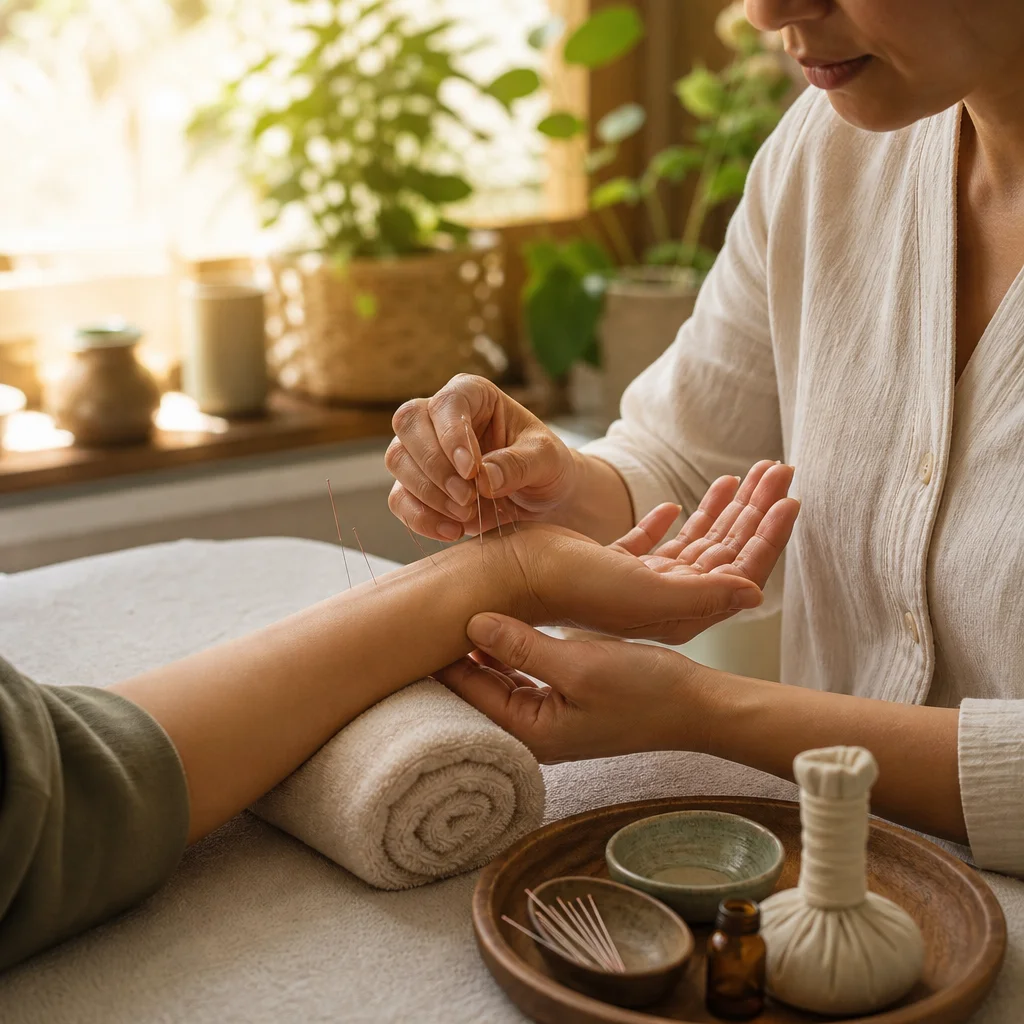
- Needle placement at acupuncture points on the forearm, wrist, and hand that directly address median nerve compression and reduce local inflammation
- Points on the arm and shoulder to release protective muscle tension
- Distal points (often on the lower leg or foot) that leverage the meridian system to promote healing throughout the arm
- Integration with functional medicine insights: if inflammation is a key driver, we may recommend dietary modifications or targeted supplementation during treatment
Between sessions, we provide guidance on forearm stretching, ergonomic adjustments, and sometimes specific exercises to prevent re-compression. If functional testing revealed deficiencies or inflammatory drivers, we address those concurrently. This integrated approach—acupuncture plus nutrition, posture, and lifestyle optimization—is what produces lasting results.
Combining Acupuncture With Nutrition and Lifestyle Optimization
Acupuncture alone is powerful, but pairing it with functional nutrition and lifestyle changes accelerates healing and prevents recurrence.
If inflammation is elevated, we identify and reduce inflammatory triggers. This often means temporarily eliminating foods your body reacts to (determined through your health history and, if needed, functional testing), increasing omega-3 fatty acids, and adding targeted anti-inflammatory herbs or supplements like turmeric or high-dose fish oil. Your hands and wrists will thank you.
Postural and ergonomic changes matter enormously. Most professionals working at desks develop forward shoulder posture that narrows the thoracic outlet and increases tension in the forearm and wrist. We assess your setup and recommend adjustments: wrist position at your keyboard, desk height, monitor position. Small changes compound into significant relief.
Sleep quality and stress management are non-negotiable. When you’re chronically stressed or sleep-deprived, your nervous system stays in a sympathetic (fight-or-flight) state, maintaining muscle tension and inflammation. We discuss sleep hygiene, stress-reduction practices, and sometimes recommend specific supplements like magnesium glycinate to support nervous system relaxation and overnight healing.
Real Results: What You Can Expect
Outcomes vary based on how long you’ve had symptoms and how comprehensively you address underlying drivers, but patterns emerge consistently in our practice.
Within three to four weeks of starting acupuncture:
- Nighttime numbness and tingling diminish or resolve
- Grip strength begins to improve
- You can return to normal work tasks without pain
By eight weeks:
- Most patients report 70 to 90 percent improvement
- Hand function is near or fully normal
- You sleep uninterrupted without waking to numbness
The key variable is adherence to the functional medicine recommendations. Patients who combine acupuncture with ergonomic adjustments, anti-inflammatory nutrition, and stress management typically recover faster and stay recovered. Those who treat acupuncture as a standalone fix, without addressing root causes, often experience symptom return as treatment spacing increases.
We measure progress objectively. Before starting, we assess your grip strength, range of wrist motion, and symptom severity. Every few weeks, we reassess to confirm measurable improvement and adjust the protocol if needed. You’ll know when you’re ready to reduce treatment frequency because function and comfort have genuinely improved, not because we’ve simply scheduled you less.
Why Boston Professionals Choose WellFit Studio

We understand that your time is precious and your standards are high. You don’t want a conveyor-belt clinic where you’re a chart number. You want a provider who listens, investigates thoroughly, and delivers results.
Our approach combines rigorous acupuncture training with functional medicine expertise. Unlike practitioners who offer acupuncture as one service among many, we integrate it with comprehensive functional assessment, advanced lab testing, and personalized nutrition coaching—all designed to resolve your condition at the root rather than manage it symptomatically.
You’ll work with a practitioner who spends unhurried time understanding your history, your work demands, and your health goals. Your treatment plan is designed for you, not templated for carpal tunnel broadly. And because we address underlying inflammation, hormonal patterns, and lifestyle factors, you recover more completely and stay recovered longer.
Your Next Step to Pain-Free Hands
If you’re experiencing carpal tunnel symptoms and want to avoid surgery while actually addressing what’s causing your compression, schedule a consultation with us. We’ll assess your specific situation, explain what we’re seeing, and outline a clear path forward—no pressure, no sales pitch, just expertise and care.
Your hands do remarkable work. They deserve better than a band-aid approach. We’re here to help you heal them naturally and completely, so you can return to the work you do best.
For further reading: Acupuncture with functional medicine.
Frequently Asked Questions (FAQ)
How quickly can I expect relief from carpal tunnel pain with acupuncture?
Most of our patients begin noticing meaningful improvement within 4-6 sessions, though some experience relief sooner depending on how long they’ve had symptoms and the severity of nerve compression. We typically recommend a course of 8-12 treatments spaced weekly to address the underlying cause rather than just masking pain. Many of our Boston professionals find they can return to their regular work demands without limitation within 6-8 weeks of starting treatment with us.
What makes your approach to carpal tunnel different from just getting acupuncture elsewhere?
We don’t treat carpal tunnel as an isolated problem. Our functional medicine assessment identifies what’s driving your nerve compression, whether that’s postural patterns, nutritional deficiencies, inflammation, or biomechanical imbalances. We combine acupuncture with personalized nutrition guidance and lifestyle modifications so you’re addressing root causes, not just needling the same points every visit. This integrated methodology is why our patients achieve lasting results rather than temporary symptom relief.
Will I still need surgery if acupuncture doesn’t work for me?
Surgery remains an option, but we find that our comprehensive approach resolves most cases without it. We’re transparent about your progress and will discuss next steps with you if we’re not seeing the improvement we’d expect by week 6. That said, we’ve helped many patients avoid surgery altogether by combining acupuncture with our functional diagnostics and targeted nutrition work that reduces inflammation and restores nerve function.


